If you are unfamiliar with the rules and paperwork when you want to exports goods from China to Europe, no worry, we will walk you through the most important steps. Whether you are new to exporting or expanding into the European market for the first time, it is essential to understand the customs formalities such as CE marking to EORI numbers and import duties. In this article, we will explain the most important customs terms and what you need to prepare before exporting goods.
First of all, what are customs formalities? Customs formalities refers to all the official steps, checks and paperwork when goods cross a country’s border. These steps include:
- Declaring what is in the shipment
- Paying any import taxes or duties
- Providing the correct documents (like invoices, certificates, or licenses)
- Making sure the goods meet EU standards
Checklist: What to prepare before exporting to Europe
Prepare the correct export documents
- Commercial invoices that clearly match the goods shipped
- Shipping documents such as CMR (road transport), Air Waybill (air freight), or Bill of Lading (sea freight)
- Packing list with description, weight, dimensions, and number of packages
- Correct HS codes (customs codes): make sure they match the product description and material type
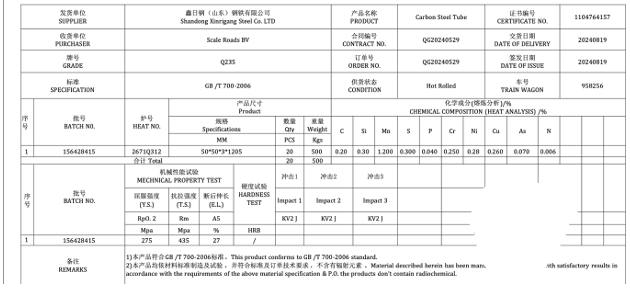
(product type→ 940511…, product type → 9403…) - MILL test reports or other proof of origin for products such as metal parts (often required due to sanctions on Russia)
Russia sanctions
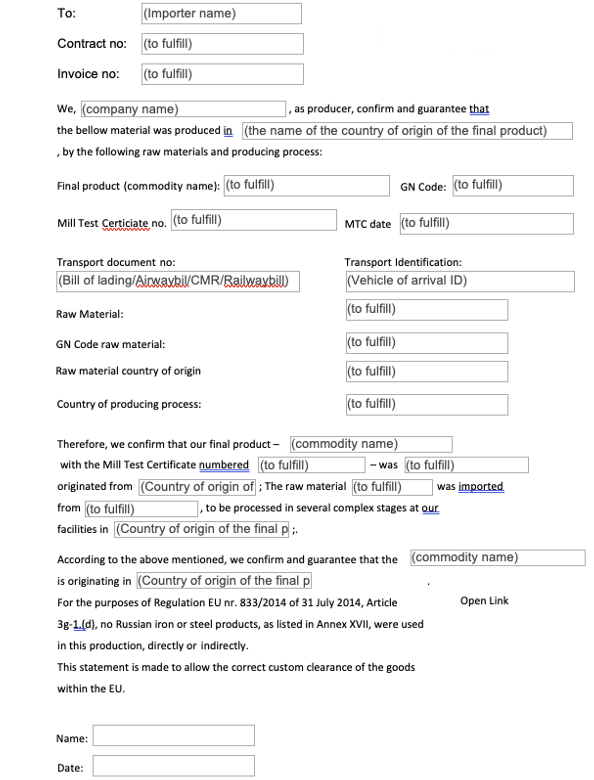
- Provide a signed statement confirming your products do not originate from Russia
- Include MILL test reports or export certificates to verify the source of raw materials (see below for an example of a MILL test certificate)
- A copy of the export certificate (as proof of origin)
- Fill in any additional documents requested for sensitive items such as stair railings or metal brackets
- See below for the an example of import control for EU import restrictions for Russian Iron/steel
CBAM: Carbon Border Adjustment Mechanism
- This applies to goods listed in Annex I of EU Regulation 2023/956, including steel, aluminum, cement, fertilizers, and others
- On company letterhead, provide the following statement:
“Hereby …[company name]… declares to be aware of the reporting obligations subject to CBAM products according to Regulation (EU) 2023/956.”
Include: invoice number, date/place, authorized signature, and company stamp
EORI number
- You need a valid EORI number as an importer based in EU
- Non-EU companies must apply through the EU country where they first plan to perform customs operations
CE marking
- The product must meet EU safety, health, and environmental standards
- Prepare technical documentation and a declaration of conformity
- Some products require certification by a Notified Body (especially electronics, machinery, and protective equipment)
Invoice details and product materials
- Include clear product descriptions
- Specifiy the materials used (plastic, glass, or metal)
- If one product includes more than one HS code, explain how it is divided
- Double-check that the HS code matches the correct material classification, e.g.:
- 9405115000 → made of glass
- 94051140 → plastic or ceramic
- 94051190 → other materials
Customs declaration
Customs declaration is an official document that gives details of goods that are being imported or exported into or out of EU customs territory. Usually, the declaration is made by the owner of the company. In most situations, the person or company making the declaration must be based in the EU. This means they must have a registered office or branch in a European country. When exporting goods from the European Union, the export procedure is a legal requirement. This process ensures that all EU rules are followed, especially for goods that are subject to export restrictions or special controls. The export process has two main stages. First, the exporter or their representative must submit an export declaration electronically through the Export Control System (ECS). This is usually done at the customs office where the exporter is registered or where the goods are packed or loaded for shipment.
The second stage takes place at the customs office of exit, such as a port, airport, or terminal, where the goods are physically presented. Customs officials check that the shipment matches the declaration and supervise its departure from EU territory. Until the goods actually leave the EU, they remain under customs supervision.
What is an EORI number?
EORI stands for “Economic Operators Registration and Identification.” It is a unique number that every business or person involved in customs activities within the EU must have. Without an EORI number, it is impossible to clear goods through EU customs, whether you are importing, exporting, or moving goods in transit.
The purpose of the EORI number is to identify economic operators across the entire EU with one standardized code. This helps both businesses and customs authorities work more efficiently when it comes to processing, security, and statistics. Each business or person can only have one valid EORI number at a time, and it must be shared with customs every time a declaration is made.
Businesses based in the EU must apply for an EORI number in their own country. If you are a company based outside the EU but plan to handle customs operations like submitting declarations or acting as a carrier, you will also need an EORI. In that case, the application goes through the country where you first plan to operate.
An EORI number starts with a country code (like NL for the Netherlands or DE for Germany), followed by a unique identifier, usually made up of numbers and letters.
What are import duties?
Import duties are taxes that must be paid when goods enter the European Union from outside the borders. These duties are meant to protect EU industries and ensure fair competition by making sure imported goods do not undercut local products in price. The amount you pay depends on the type of goods, where they come from and their customs value. For example, importing clothing from China will have a different duty rate than importing electronics or food products.
What is CE marking?
CE marking is a certification mark that indicates a product complies with European Union (EU) safety, health, and environmental protection requirements. CE marking applies to a wide range of products, including electronics, toys, medical devices, and machinery. For exporters from China or other non-EU countries, this means your product must be tested and certified according to EU rules before it reaches the European market.
Frequently asked questions (FAQ)
How does VAT work in Europe?
In the EU, VAT (Value Added Tax) is charged on the import of goods. In the Netherlands, import VAT is typically 21%. However, if you are a registered importer with a VAT deferment license (Article 23 permit), you can postpone the VAT payment to your VAT return. This improves your cash flow.
How long does customs clearance take?
Customs clearance can take anywhere from a few hours to 1–2 business days, depending on:
- Whether all documents are complete
- Whether customs requires a physical inspection
- Product type and origin
What are HS codes, and how are they used?
HS codes (Harmonized System codes) classify products for customs purposes. The EU uses the 8-digit or 10-digit version based on the international 6-digit system.
Need help with EU customs procedures?
At MN Logistics, we specialize in helping Chinese exporters successfully enter and operate in the European market. Whether you are shipping for the first time or expanding your reach, our team is here to support you with reliable customs handling, documentation, and logistics coordination.
If you have questions or need tailored advice for your situation, feel free to contact us. We are happy to support!