A container arrives in Rotterdam, but your customer cannot take the goods yet. Unloading into a warehouse can separate cargo storage from use of the shipping line’s equipment. Whether that reduces the total cost depends on free time, handling, trucking, storage and the agreed empty return.
Demurrage, detention and storage are different
Demurrage generally concerns time before the full container leaves the terminal. Detention generally concerns time after it leaves until the empty equipment is accepted back. Carrier definitions, counting rules and combined arrangements vary. Terminal storage may be included in a charge or billed separately: check the booking and applicable tariff. 1 2
Warehouse storage concerns the cargo after unloading. Container devanning or stripping does not, by itself, stop the equipment charge: the empty must reach the agreed return location and be accepted.
Plan unloading before free time runs out
Confirm the vessel arrival, terminal release, customs status and free-time calculation. Then align the truck collection, unloading slot and empty return.
MN Logistics connects container transport with warehousing, palletising and customs. This can support overseas forwarders whose European customers need phased deliveries.
Compare the complete alternatives: leaving the full container, moving it to an agreed depot, or unloading and storing the goods. Include both truck movements, handling, pallet materials where needed, cargo storage and any remaining carrier charges.
What affects container devanning charges?
Unloading costs depend on the packing method, goods and quantities, handling requirements and any sorting or palletising. Ask for a quote that separates unloading, pallet materials, cargo storage and onward transport from the shipping line’s container charges. Include the expected storage period and release schedule so the alternatives can be compared on the same basis.
Check the shipping line’s actual method
Maersk: check the Netherlands import page together with your booking, including any SPOT-specific conditions. Establish the demurrage and detention start/end events, calendar-day counting, free days and approved empty-return location. Use the current applicable block, not an expired local advisory. 1
CMA CGM: obtain the applicable Netherlands import tariff and booking conditions. Confirm whether storage is included in demurrage or charged separately, then calculate the relevant demurrage and detention periods. Public documents can differ; use the version applicable to your shipment. 2
COSCO: use the Netherlands charge calculator and confirm the booking conditions, including whether charging is split or combined. Check the agreed empty-return depot and acceptance date; an older tariff is not proof of the current arrangement. 3
Keep the gate-out record and empty-return receipt or Equipment Interchange Receipt (EIR). An EIR records the container interchange; it is useful evidence when checking billed dates. 4
Practical invoice example
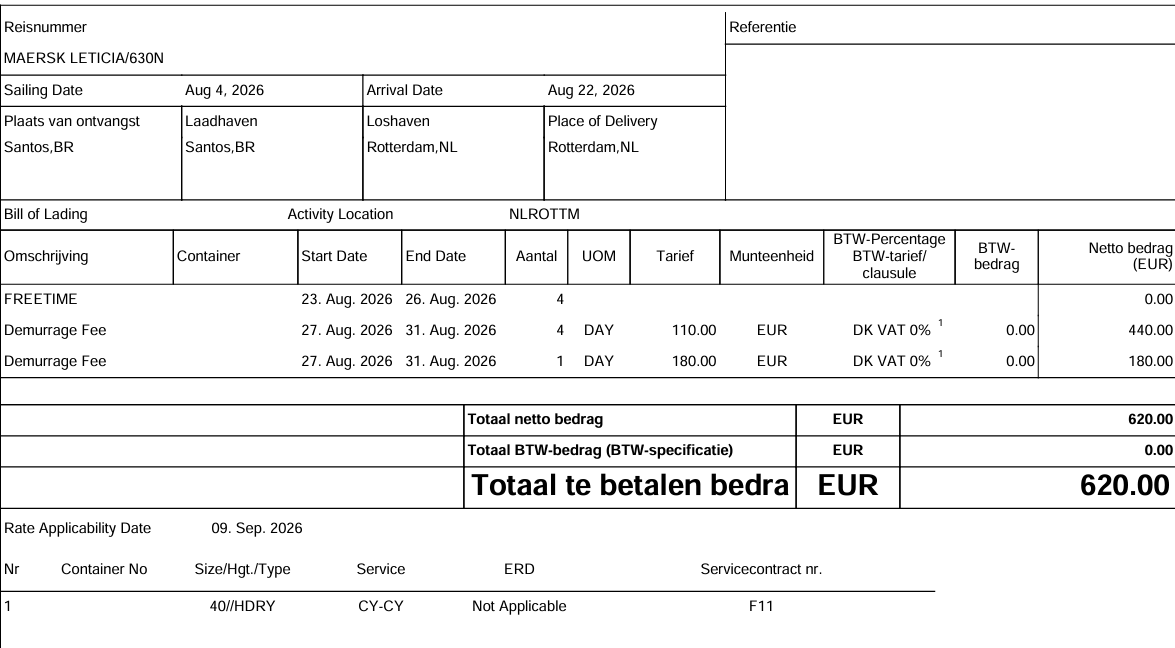
The published MN Logistics example shows four free days followed by €440 and €180 in demurrage: €620 total. 8 It illustrates how extra days can accumulate, not a current standard tariff. Free time, amounts and counting depend on the shipment.
Frequently asked questions
What if several containers arrive together?
Reserve unloading capacity around the expected release dates. Check each container’s free-time deadline separately and agree the sequence, truck slots and storage requirements.
Can I leave the full container at a depot?
Only where the location and equipment arrangement allow it. Moving the full container does not automatically stop detention or other charges. Compare the complete cost with unloading the cargo.
Does a customs inspection stop demurrage?
Not automatically. In MN Logistics’ operational experience, charges often continue during an inspection. Check the applicable conditions, keep the inspection and release timeline, and request any review through the carrier’s process. A waiver is not guaranteed.
Can Portbase prove the empty return?
Only for relevant connected terminals or depots and the available service data. Portbase Road functionality differs by location; it is not universal proof for every depot. Keep the actual acceptance receipt. Secure Chain release for terminal collection is a separate process. 5 6
Who pays detention under DDP?
Check the sale contract, carrier booking and transport agreements. An Incoterms rule in the sale contract does not by itself settle every obligation under a separate carriage contract. 7
What should I check on an invoice?
Check container number, applicable tariff, free time, charge period, full gate-out and accepted empty-return date. Compare the billed events with receipts and booking conditions; follow the carrier’s dispute procedure promptly.
Arrange your European handling flow
Send MN Logistics your container type, goods, packing method, Rotterdam arrival, customs status, storage period and delivery destinations. We can assess unloading and storage in the Netherlands or Germany alongside the required customs and trucking.
Contact MN Logistics to discuss container unloading, storage and onward deliveries.
Sources
[1] Maersk: Netherlands import
[2] CMA CGM: demurrage and detention tariffs
[3] COSCO: Netherlands charge calculator
[4] Maersk: shipping glossary
[5] Portbase: Road functionality by location
[6] Portbase: Secure Chain
[7] ICC: sale and carriage contracts