Shein and Temu face major setbacks in the U.S. after the end of the de minimis trade exemption. What does this mean for fast fashion, logistics, and global e-commerce?
Shein and Temu have been affected by the Trump administration’s decision to end a trade policy that is important to their business model. Shein and Temu are brands who offers ultra-cheap clothing, home goods and accessories delivered from China. In recent years, Shein and Temu has become a well-known fast fashion brand in the U.S. Their success was built on a special U.S. trade rule, which is de minimis exemption. This allowed packages worth less than $800 to enter the country duty-free. However, this loophole will close on August 29, 2025. This means higher prices and slower deliveries for American shoppers. For Shein and Temu, and the logistics and e-commerce world, this will change a lot.
At MN Logistics, we follow developments in international trade policies because they directly impact how goods move between China, Europe, and the U.S. So what does this change mean, and why is it so important for companies like Shein and Temu and their competitors such as Amazon, Walmart, and European retailers?In this blog, we will explore this in more detail.
What is the De Minimis Exemption?
The de minimis rule comes from the U.S. Tariff Act of 1930, which allowed packages under $800 to bypass duties and customs checks. This rule became the backbone of Shein and Temu’s business model.
- By 2023, over half of all de minimis shipments came from China.
- More than 30% were linked directly to Shein and Temu.
- This model allowed millions of low-value shipments to enter the U.S. at high speed and low prices.
With the policy ending, that cost advantage disappears.
Impact on Shein and Temu?
In response to shifting U.S.-Chinese trade policies, Shein and Temu announced in early April that prices will be increasing on both platforms.
- Price increases → Both platforms confirmed prices will rise, though the exact scale remains unknown.
- Slower shipping → Packages will now face full customs clearance, causing delivery delays.
- Declining popularity → Between April to June 2025, Temu’s app downloads dropped 77%, while Shein fell 51%.
- Reduced U.S. focus → Both companies cut U.S. advertising by over 60% in Q2 2025, shifting investments to other regions.
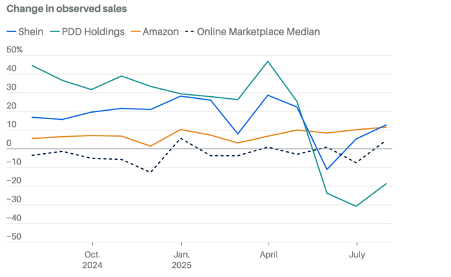
Shein and Temu’s parent company, PDD Holdings, has already seen sales decline as a result. Amazon has benefited from the companies’ setback. Below we have included a graph that shows observed sales by online marketplace based on credit and debit card transactions (figure 1)
Who benefits from this change?
With Shein and Temu losing their advantage, other players are stepping in:
- Amazon → Already gaining market share, with U.S. sales rising 11.6% in July 2025, outperforming the industry.
- Walmart & Gap → Regain competitiveness by combining strong supply chains with faster domestic delivery.
- Etsy → Increased its ad spend to attract shoppers leaving Shein and Temu.
- European retailers → Stand to benefit as U.S. consumers explore alternatives with more regional supply chain stability.
The company that seems to be gaining the most from Shein and Temu’s struggles is Amazon. Between March and July, Amazon’s U.S. sales grew at an average of about 9% per year. In July, sales jumped 11.6% that beats the overall industry.
Why this matters for logistics
From a logistics perspective, this change highlights howpolicy and regulation shape the logistic industry. For years, Chinese companies optimized around the De Minimis Exemption to move goods cheaply and quickly. With that door closing, we expect:
- A rise in bulk shipping into the U.S. and Europe
- Increased demand for warehousing and customs brokerage
- More demand for trusted logistics partners who can navigate customs efficiently
Frequently Asked Questions (FAQ)
What is the De Minimis Exemption in U.S. trade?
The De Minimis Exemption allows goods valued under $800 to enter the U.S. duty-free and without formal customs clearance. It was widely used by companies like Shein and Temu to ship low-value packages directly to U.S. consumers.
Why is the de minimis exemption ending in August 2025?
The Trump administration decided to close the loophole to protect U.S. retailers, increase tax revenues, and reduce dependency on low-cost imports from China.
Are Shein and Temu leaving the U.S. market?
At this moment not, but they are reducing their U.S. focus. Both companies cut advertising spend in the U.S. and may shift attention to other markets where trade rules remain more favorable.
Why Choose MN Logistics?
At MN Logistics, we follow these policy changes closely because they directly affect how goods move between China, Europe, and the U.S..
We see this moment not only as a disruption, but also as an opportunity for companies to build stronger, more efficient supply chains.
Need advice on how these changes may impact your business?
Looking for a logistics partner who can help manage warehousing and customs processes?
Contact MN Logistics today, we are here to support you!